Summary:
- Vobile analyzed nearly 1,000 AI covers on Spotify
- First, the songs were confidently flagged as AI by Vobile’s AI Song Detector
- Next, the AI covers were mapped back to the original songs by Vobile’s Cover Song Identification
- ONE platform generated 97% of the AI covers identified
The mechanical royalty “black box” doesn’t need any new additions, but AI-generated cover songs are certainly going to make proper attribution for publishers even harder. While AI-generated cover songs aren’t inherently bad, they can have negative impacts for artists and songwriters, especially because of the increasingly high volume of AI tracks on DSPs. Deezer recently reported that 90k daily uploads to its platform are AI-generated, accounting for 50% of uploads.
When original AI-generated songs – like the viral TikTok audio “The Puerto Rico Song” – are uploaded to DSPs, they may not be high quality, but they aren’t eating anyone’s lunch.
When AI-generated covers are uploaded to DSPs at high volumes, they not only create confusion for listeners who want to hear the original song, they also create an influx of music that needs to be attributed to publishers.
If these covers are not flagged as AI, they could “steal” streams from original recordings that are already properly matched in The MLC.
Additionally, if the covers aren’t matched to their original compositions due to a lack of metadata from AI platforms and DIY distributors, then unclaimed royalties in the “black box” will increase as rapidly as AI music does.
We analyzed around 1k AI cover songs on Spotify and matched them to their original compositions
A bit of good news: AI covers are hiding in plain sight. We analyzed about 1k songs in the Spotify playlist “All Best AI Covers 2026” using our AI Song Detector and cover song identification technology.
Our two-pronged approach to identifying AI cover songs
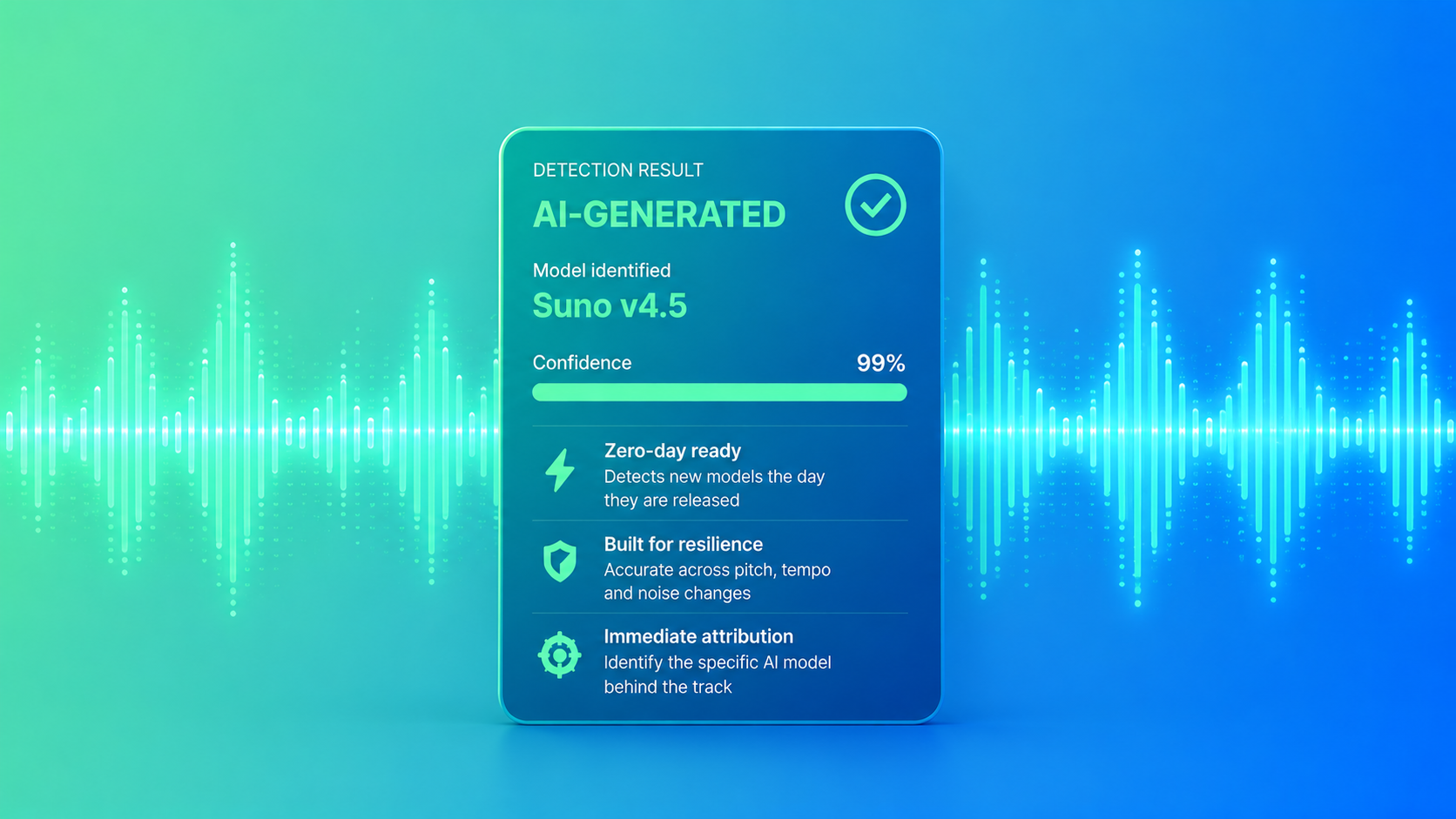
AI detection: A model determines whether the track is AI-generated and identifies which tool produced it.
Cover song identification: The track is fingerprinted on melody and lyrics/vocals, then matched against Vobile’s Music Registry to surface the original composition.
After confirming these songs are AI-generated and identifying the original songs, we looked for other trends and insights. Here’s what we found.
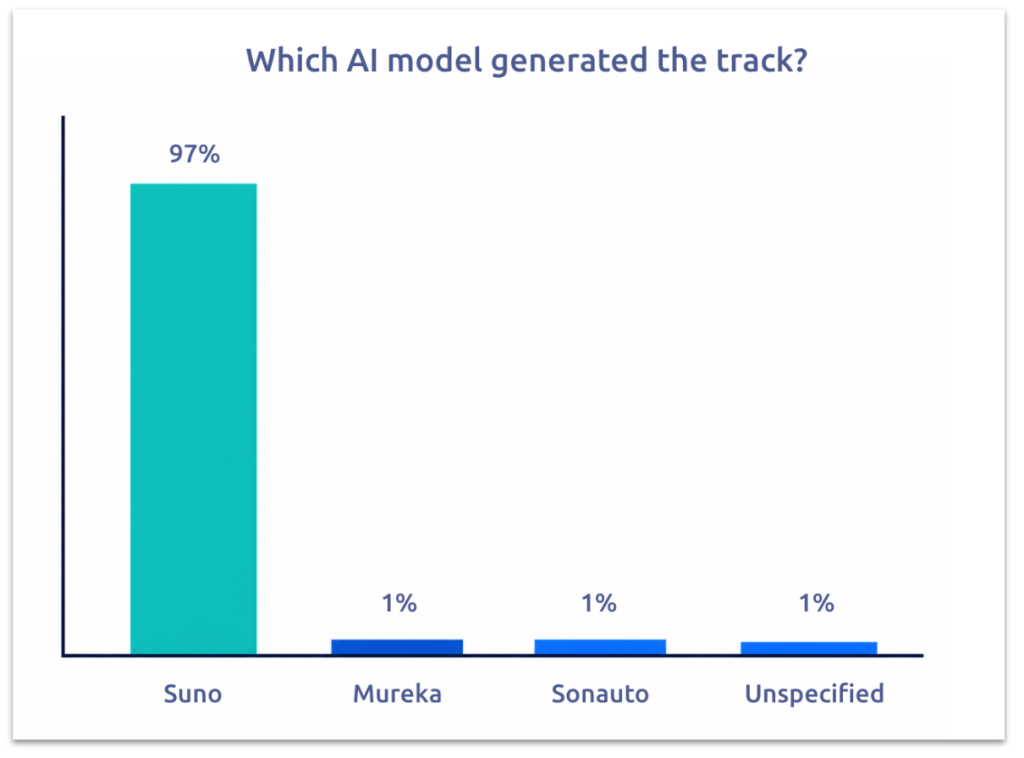
Suno generated 97% of the AI cover songs we identified
We can also identify which AI model generated the track. Suno dominates this playlist with 97% of the songs being generated by their platform. Mureka and Sonauto make up the small remainder.
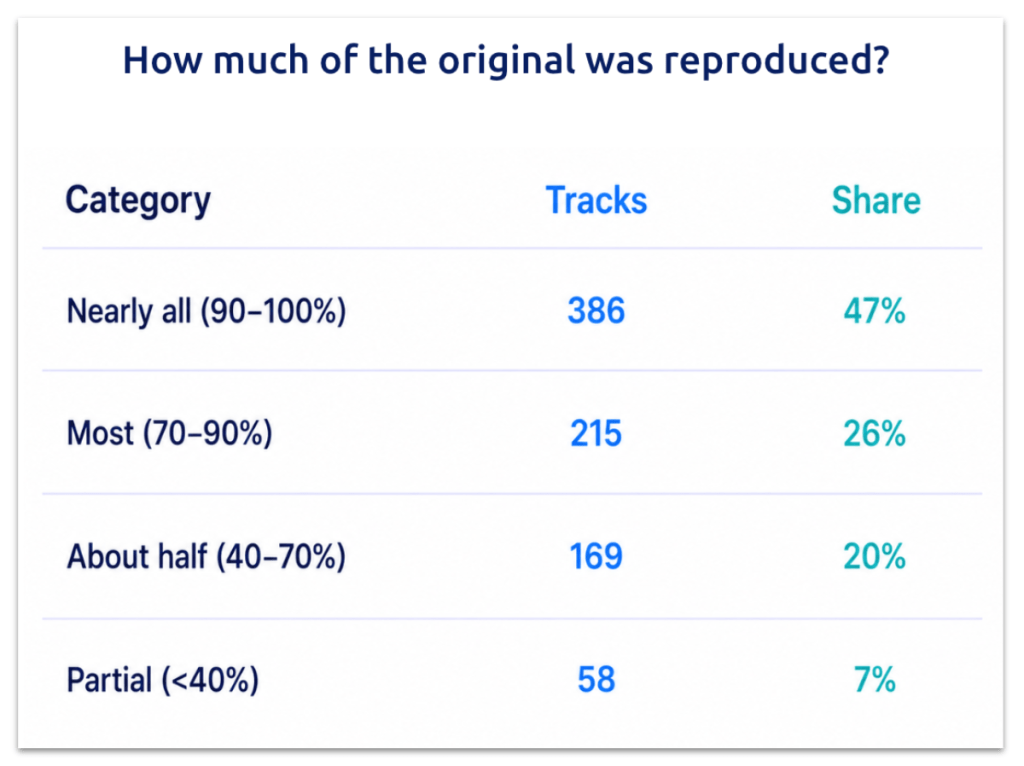
That’s definitely a cover song: 47% of identified covers reproduced at least 90% of the original work
Even more, 73% of identified covers reproduced at least 70% of the original. There is a definite copyright claim for these AI cover songs, and publishers need to be getting paid properly.
No one-hit-wonders here: The most covered song has 18 AI distributions in just one playlist
Some songs are being covered by AI repeatedly, meaning a single composition is generating royalty-bearing streams across many separate tracks, each needing to be matched back to it individually.
“Stand By Me” (originally recorded by Ben E. King) accounts for 18 separate AI covers just in this one playlist. Michael Jackson’s “Billie Jean” has 10.

Fraud alert: The impact of high-volume AI covers
Fraudsters use AI generators to flood platforms with large numbers of tracks, streaming each one modestly enough to avoid raising suspicion. Small per-stream payouts, multiplied across millions of tracks, add up to real money. This isn’t hypothetical: in 2024, a North Carolina man pled guilty to a scheme that used AI-generated songs and fake streams to collect millions in royalties.
Not every AI cover is part of a music fraud scheme, but the incentive to flood DSPs with AI music is the same: generating covers of well-known, high-traffic songs is cheap, and streams add up fast across multiple versions. Eighteen AI covers of “Stand By Me” in one playlist shows how common it is to create an AI cover in order to earn a piece of the royalties without doing any of the work to produce new music.
DSPs are identifying AI songs, but not AI covers
Spotify surfaces an AI disclosure in Song Credits via the DDEX standard, on top of a spam filter that has already removed more than 75 million low-quality or fraudulent tracks.
The gap sits one level down. Disclosure that a track is AI-generated isn’t the same as identifying which specific composition it covers or how much was reproduced. Deezer’s auto-tagging flags a track as AI, but doesn’t tell a publisher it’s a 99% match to “Stand By Me.” The EU’s AI Act mandates machine-readable marking of AI-generated audio from generative AI platforms, but doesn’t require any labeling for AI covers. Rightsholders and music listeners need to know not just whether a track is AI, but also which song it covers and how strong the match is.
What this means for music publishers
The bottom line is: music publishers and songwriters need to be paid for AI covers. AI exacerbates every existing issue with music identification and remuneration, and this is no exception. The volume of AI songs and covers, coupled with a lack of regulation, makes it difficult for publishers to find and monetize AI covers. Benefiting from AI covers requires knowing the covers exist and getting them properly reported or claimed, so royalties can be paid out. With a single song being covered 18 times in just one playlist, this is a problem that requires technology at scale.
We can help: Identify AI cover songs with Vobile
Vobile’s AI Song Detector and advanced cover song identification finds AI covers for music publishers with high accuracy. Our solutions work at the scale of the internet, and can handle the high volume of AI-generated songs. Our technology is robust and can match melodies and lyrics despite modifications in speed, pitch, voice, or language.
Enforcement & rights: We can identify AI-generated songs and determine if the track is a cover, know what composition was used, and show how much of the original was covered.
Scale: No human listening is required to reach these results. Our advanced technology identifies AI-generated songs in seconds, and then we can check the songs against our registry of 150M+ commercial recordings to determine any covers.
Transparency: Every decision comes with a confidence score, the name of the platform that generated the song, and shows what percentage of the original was covered.
Market insight: If checking a large amount of songs, like a public playlist or entire catalog, we can see which AI platforms are most used and which songs are most covered.
Publishers and songwriters deserve to get paid for their works. Unauthorized AI cover songs are using popular compositions to earn royalties that are never shared with the proper rightsholders. As the volume of these AI covers increases, publishers need a solution that can keep pace with generative AI tools. Vobile’s AI Song Detector plus cover song identification are the answer.
Reach out to our team today to get started or see a demo.