
Earlier this year we published a report on the state of modified audio across user-generated content (UGC) platforms for 2023. We found hundreds of millions of modified audio tracks were distributed in 2023 across 20 plus social media platforms, which was an estimated 19% of all identified content. Now we are back to share which of the most popular songs in Q1 racked up the highest number of manipulated matches, creating potentially missed royalties for music rightsholders.
Modified audio matters for proper attribution
Modified audio, also referred to as manipulated audio or songs, is rising in popularity. Trends like nightcore are creating more remixes than ever before with tracks that aren’t properly licensed, which means the new creator gets all the credit and cash instead of the people who actually made the original song. Since the attribution information points to the remix creator and not the original rightsholders, the original creators may miss out on royalty payments from their work being used. Licensing and proper attribution are critical for rightsholders to get credit and cash for the use of their songs.
Methodology
Pex indexes publicly available content from digital platforms and does not use any platform APIs or tools to report data. We tracked songs from Billboard’s Hot 100 list from March 2024 across 20+ social media platforms to identify which had the most modified audio matches. The matches we found are considered “all time,” meaning any matches that had been on the internet up to that point. Please note newer songs may have less matches, and music released earlier may have more matches. We defined modified audio as any audio where the speed was changed by at least 1 percent and/or pitch was changed by at least 25 cents (0.25 semitones).
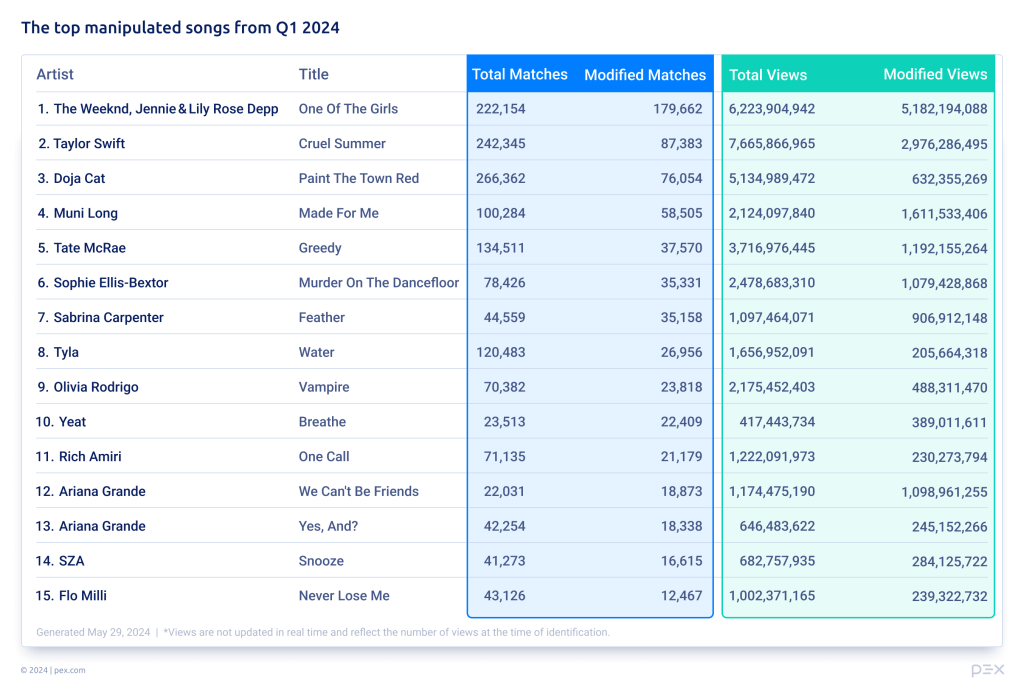
“One Of The Girls” by The Weeknd, Jennie & Lily Rose Depp manipulated version makes up 80% of its total matches on the internet
We define a “match” as a reupload of an original song. For example, when music is added to social media videos or is sped up and then distributed on DSPs. Our audio identification technology found over 220k matches of “One of the Girls,” a song made popular by the HBO show “The Idol.” Of those matches, more than 179k (80%) were modified versions of the original song. Modified versions can be harder to identify, and they are almost always credited back to the modified creator, not the original artists. Having a song go viral in user-generated content (UGC) has been touted as free promotion for artists, but as we can see here, the manipulated versions and their creators are getting much more attention, and potentially money, than the original artists.
Manipulated versions draw more than half of views for four out of the top 10 songs
Without views or streams, reuploads of songs are usually pretty insignificant news. Views and streams are what drive revenue, and what makes modified audio such an issue for music rightsholders. When modified versions amass enough attention to start earning royalties or ad revenue, those miscredited funds are considered music fraud.
Four out of the top 10 songs we tracked have more cumulative views from their modified matches, than from matches to the original version: “One of the Girls”, “ Breathe”, “Feather”, and “Made for Me.” For “Breathe” by Yeat, 93% of the views across all matches are on modified versions, illustrating just how popular modified audio is, and how it can overshadow an original version. And Ariana Grande’s “We Can’t Be Friends” views are nearly all from modified copies.
TikTok was the platform with the most modified audio
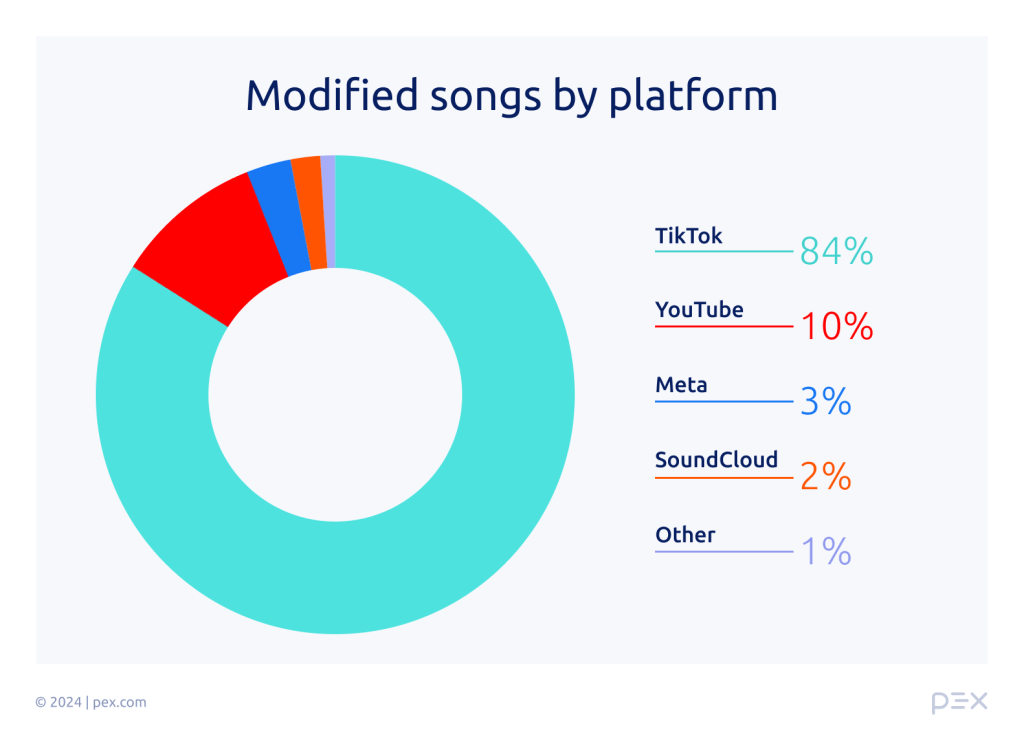
TikTok has become a place to discover and share new music, so much so that artists make TikTok dances for their new releases, people create streaming playlists of TikTok hits by the month, and many an artist has found fame from a 30 second video. Naturally when tracking some of the biggest hit songs, we’d find TikTok has the most total matches, and the most modified matches. Out of 783,305 total modified matches from the songs we tracked, 654,918 (84%) are on TikTok.
100k of the modified matches would not be caught by most identification technologies
One of the reasons modified audio is able to be uploaded and distributed is because it’s harder for Music Recognition Technology (MRT) to identify modified versions. If an MRT solution was even trained on sped up or slowed down audio, it may have only been trained to detect a certain amount of modifications, allowing many manipulated tracks to skate past detection and rack up streams. At Pex, our audio identification technology can match speed changes between 50%-200% (half speed all the way up to double speed). We’ve found that other tech solutions can only identify speed changes between 1%-10%.
For these ten songs, we looked at how many modified matches were altered by 10% or more, to see how much would be missed by these legacy MRT providers. We found that nearly 100k matches were modified above 10% and would not be caught by other technologies.
See what you’ve been missing with Pex
We’ve sounded the alarm on how modified audio is diverting royalties across both UGC platforms and DSPs, and we’re working with rightsholders, platforms, and anyone who needs to tackle this issue. We have solutions for identifying reuploads of audio and video across over 20 UGC platforms, and for finding modified versions of tracks that have been commercially distributed onto DSPs like Spotify and Apple Music. If more platforms and music distributors were using solutions like these, music rightsholders wouldn’t be losing revenue to modified audio, and would get proper credit for their works.
We’d love to show you the magic in action. Schedule a demo with our team to learn more, or sign up for our weekly newsletter where we share modified audio we’ve identified.